A biostimulant
based on purified
humic acids.
What ProtoHumiX contains, how it is made and how to use it in agriculture. Explore the role of humic acids and the field trial results, with measurements and links to the original reports.
ProtoHumiX®
Science for agriculture
What ProtoHumiX is used for
ProtoHumiX is a liquid humic biostimulant used to support root development and nutrient uptake. It works alongside a crop’s nutrition programme, with application timing and rates matched to the growth stage.
Humic substances form as organic matter breaks down. They occur in soil, peat and brown coal. ProtoHumiX production extracts these substances from the raw material and removes accompanying impurities to produce a liquid formulation for crops.
Created by scientists and engineers
The team includes engineers, process specialists and biochemists. Their work covers humic extraction, purification and production equipment. The specification describes the formulation; farm reports and research papers document its use.
ProtoHumiX · the team and its development · Agricultural specification
How humic acids affect roots
Roots take up water and nutrients. Explore what research tells us about humic substances in the soil and their effects on root development.
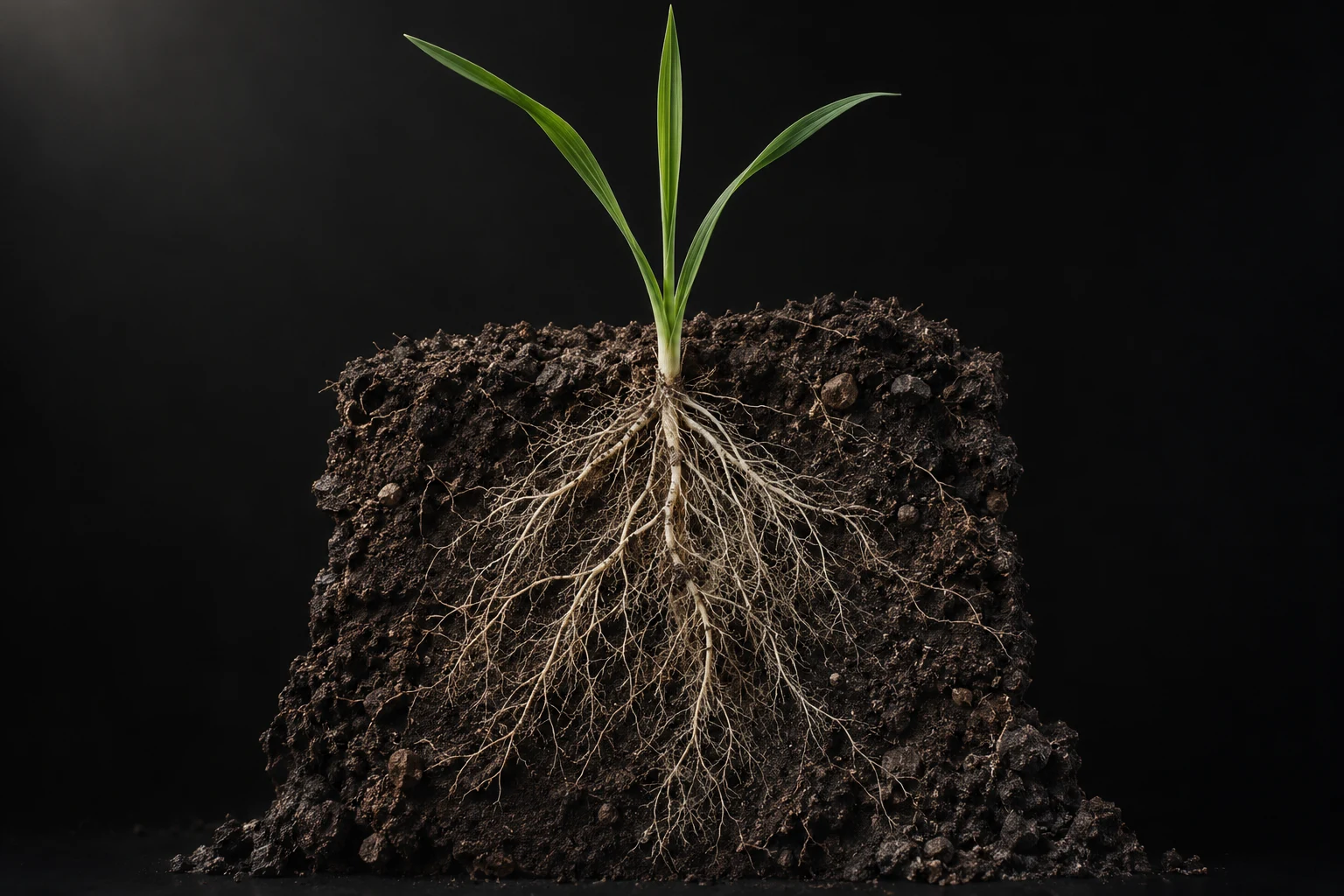
Root development
Experiments with humic acids have recorded changes in lateral-root formation and membrane enzyme activity. This helps explain why roots are a focus of biostimulant research. A response depends on the substance, dose and growing conditions.
Canellas et al. · Plant Physiology, 2002
This study concerns humic acids from vermicompost, not a trial of ProtoHumiX. It provides a biological context for the product’s field evidence.
Humic and fulvic fractions
ProtoHumiX composition
Humic and fulvic acids are families of natural organic compounds. Together they form the active humic fraction of ProtoHumiX. The manufacturer declares the following composition on a dry-matter basis.
- Humic acids
- 6.4% ± 0.6
- Fulvic acids
- 0.9% ± 0.1
Dry-matter basis as stated by the manufacturer. The bar shows the split of the declared humic fraction, not the composition of the whole liquid.
Humic and fulvic acids differ in their properties, including solubility. Consult the specification and batch documents for the composition and characteristics of the product supplied.
Original composition and tolerances · Research on extracted humic substances
How ProtoHumiX is made
Humic substances are extracted from brown-coal feedstocks, separated from impurities and processed into a liquid extract.
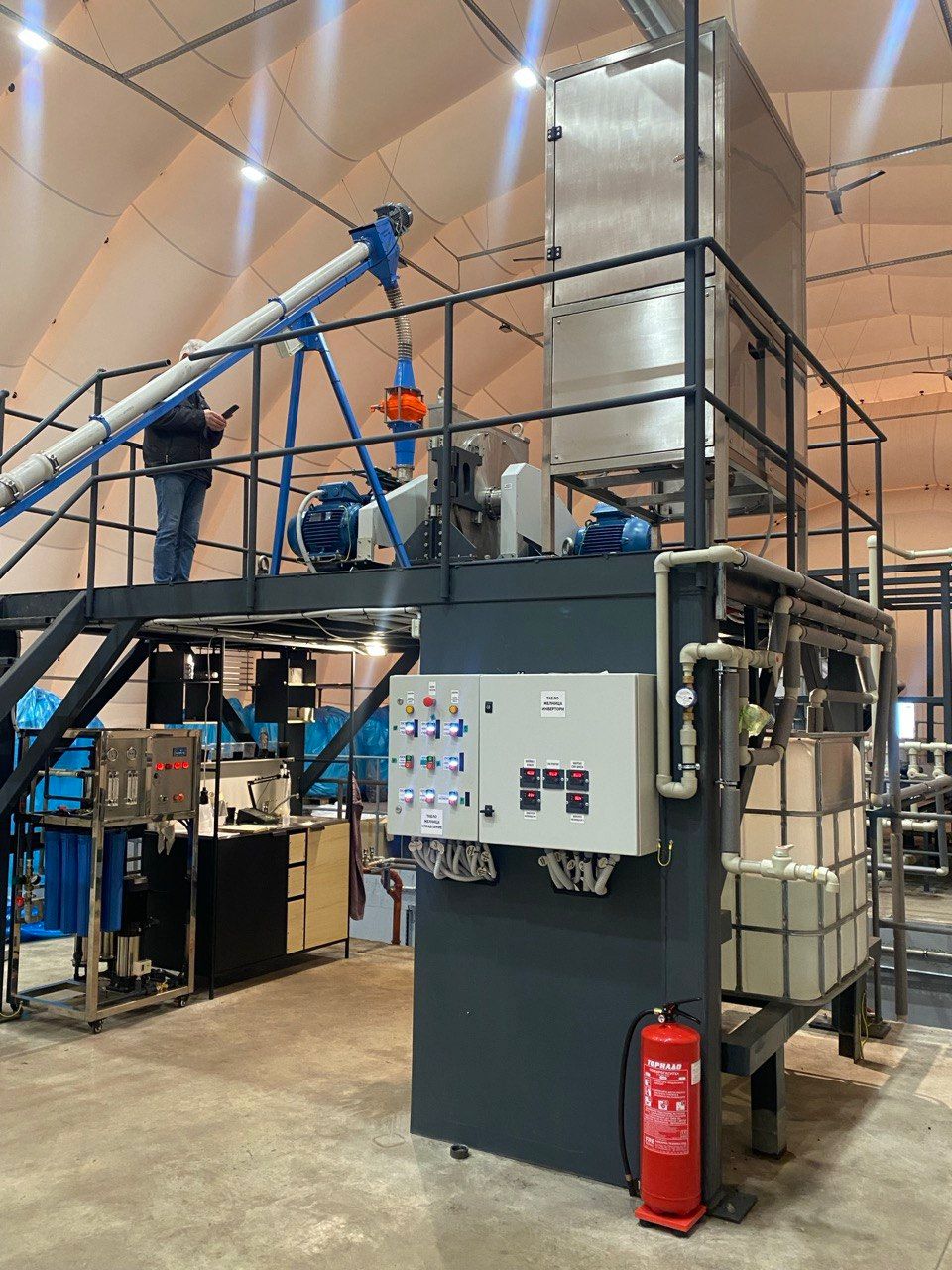
The reactor at the heart of the process
ProtoHumiX describes a technology for extracting humic substances from leonardite and other brown-coal feedstocks. These materials hold complex organic fractions alongside mineral components and other accompanying substances.
A mechanochemical reactor processes viscous media. Extraction, phase separation and purification form a connected production sequence. The process and equipment are described in the patent family, including WO2015/163785 and EP3135655.
Natural origin
Humic fractions are extracted from the organic matter of the source material.
Mechanochemical extraction
The reactor processes the feedstock to release the target fractions.
Purification & testing
Accompanying impurities are separated; the resulting extract is analysed.
Agricultural formulation
A liquid formulation, applied according to the crop and growth stage.
Testing the extract
A 2024 research paper reports composition and safety analyses of the extract, including monitored elements. These tests describe the product itself. Harvest quality requires separate analyses of the grain, seed, fruit or tubers.
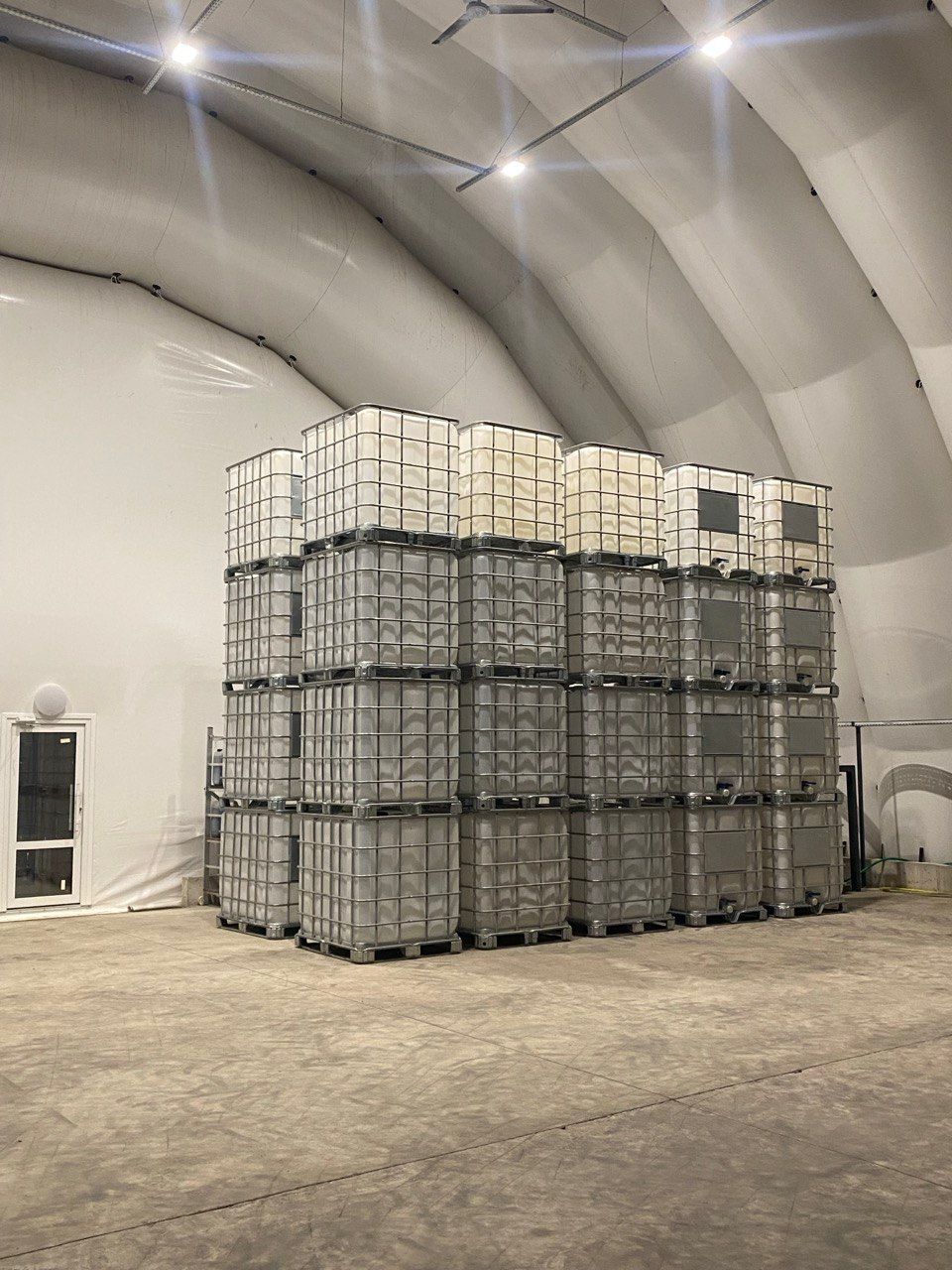
Our production site
in the European Union
Industrial equipment, process controls and storage facilities.
What crop-quality tests found
Crop value depends on quality as well as yield. ProtoHumiX trial reports include measurements of seed fat content and sugarcane juice purity, both relevant to processing.
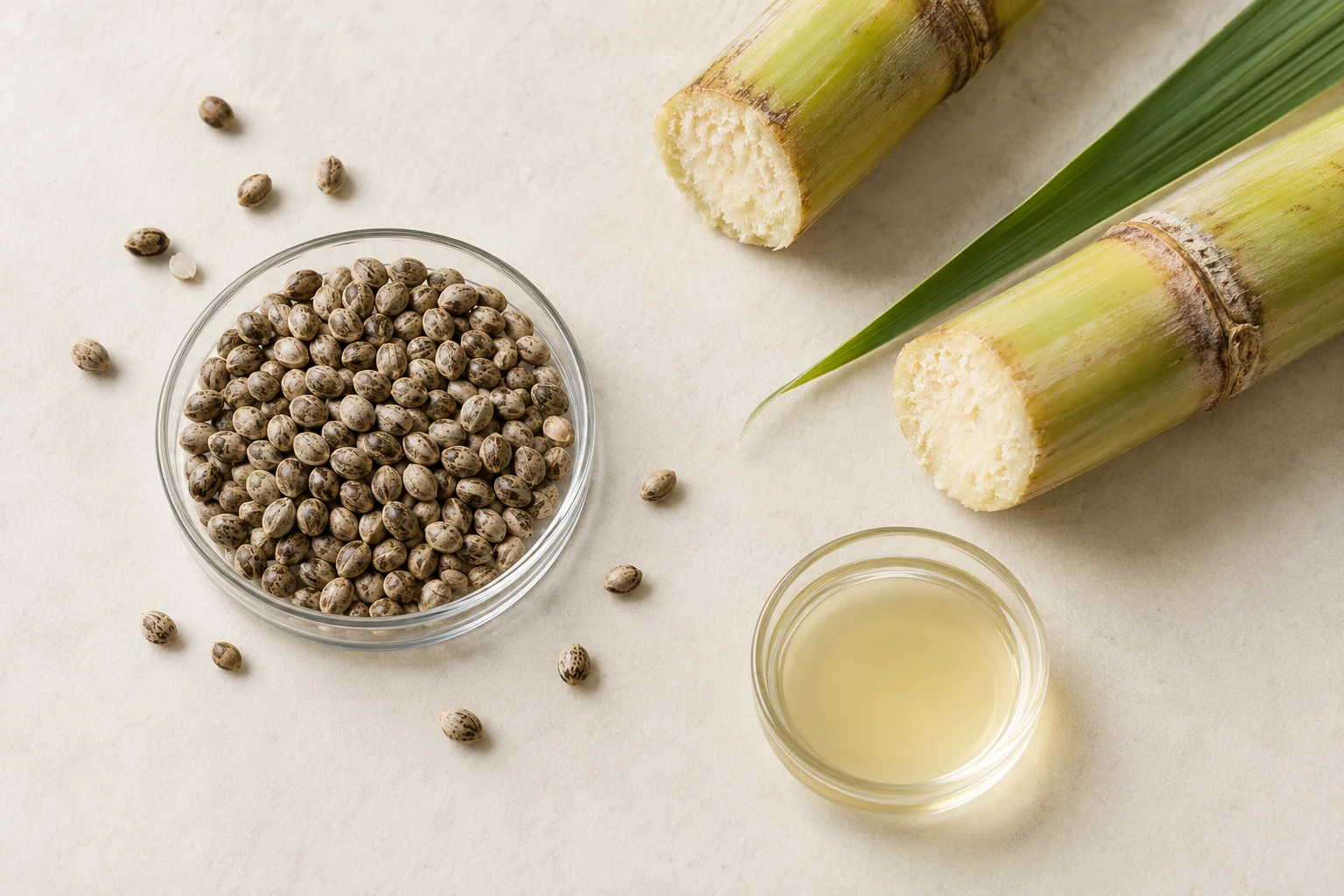
Fat content in industrial hemp seed
Paired laboratory samples, b.i.s. analytics. The measured difference is 0.5 g per 100 g of seed.
Sugarcane juice purity
A processing-quality indicator, not a measure of pesticide residues. The same report records sugar yield of 9 t/ha versus 7 t/ha in the control.
The values describe the reported samples, farms and seasons. Historical trial formulations may differ from the current product. They do not predict the result in every field; the original documents show the conditions and other measured parameters.
What can be said about pesticides in the crop?
Purification of a humic extract and pesticide residues in harvested food are different measurements. The reviewed reports do not include paired crop-residue analyses. They therefore do not substantiate a pesticide-free harvest or a universal reduction in crop-protection treatments. Such conclusions require separate crop testing.
Crop, comparator, harvest
Yield in field trials
The wheat, barley, soybean and potato reports record yields with ProtoHumiX and in the control plots. Select a crop to compare them. Trial conditions and links to the reports appear beneath each chart.
Winter wheat
Average increase across the comparisons below
Control: another biostimulant; both groups followed the farm’s standard crop-protection and fertiliser programme. Two varieties at one farm. Different product doses; this is a comparison of the reported programmes, not an equal-dose comparison.
Original reports & calculation
Each change is calculated as (treated yield − control yield) ÷ control yield × 100%. The headline is the arithmetic mean of those changes, rounded to a whole percent.
A single farm report for two varieties. Replicate counts and statistical significance are not provided; this does not establish superiority over other biostimulants as a class.
These are observations from specific farms and seasons. They do not establish a guaranteed response or a statistically validated average for every field. Historical trial programmes differ from the current application scheme.
Bionta potatoes: an Austrian trial
The Bionta potato report from 2018 records two plots of 0.08 hectares each. The control produced 380 kg; the ProtoHumiX plot produced 420 kg. The difference is 40 kg on that plot, or about 11% relative to the control. Dividing both harvests by the same area gives 4.75 and 5.25 tonnes per hectare, the values used in the chart.
This is a concrete result from an Austrian organic trial. Keeping the variety, area and comparison visible makes it possible to understand the observation and compare it with the conditions of another farm.
Root development is studied separately
The 2024 paper also includes a visual comparison of chrysanthemum roots on day 52 of cultivation. It is an observation of root-system development. The publication gives no numerical root-mass or harvest-yield comparison for this image, so it cannot supply a yield percentage.
See Figure 4, page 7How to apply ProtoHumiX
The current programme specifies 3 L/ha per cycle. The crop determines how that volume is divided between treatments.
Wheat, maize, soybeans, potatoes and other crops have their own application programmes. Each specifies the treatment stage and its share of the total volume. Browse the crop catalogue to find yours.
Choose a crop and programme in the calculator, then enter your field area. It gives the total concentrate volume and the amount for each treatment. Check the current instructions for water volume and tank-mix compatibility.
Fields, greenhouses and drip irrigation
The manufacturer describes ProtoHumiX as suitable for fertigation — applying a product with irrigation water — and greenhouse systems. The formulation contains purified, water-soluble, low-molecular-weight humic and fulvic fractions.
Floriculture and work with depleted soils are also listed applications. Match the application programme to the crop and equipment with Quinta; these uses do not have separate automatic rates in the source calculator.
For the complete growing cycle, not for every treatment.
Calculate volumeDoes ProtoHumiX replace fertilisers?
Nutrient supply and biostimulation solve related but different tasks. Plan mineral nutrition from the crop demand, soil analysis and the farm’s agronomic programme. A change in fertiliser rate needs its own field assessment; the published trials do not justify one universal reduction for every crop.
How can a farm check its own response?
Compare treated and control plots with matched conditions and keep the rest of the programme consistent. Record variety, soil, weather, dates, application rates and harvested yield. Replicated plots and an agreed sampling method make the result easier to interpret. Use the source reports as context, then discuss the design of a local trial with an agronomist.
Read the full context
ProtoHumiX documents and sources
The manufacturer lists the following certification references for the agricultural product. For a supply decision, request the current signed certificate and the batch documentation from Quinta.
- Non-microbial plant biostimulant · PFC 6(B)
- CE-B/17/25/BS
- Inorganic soil improver · PFC 3(B)
- CE-B/5/26/BS
- Use in organic agriculture
- SE/132/2025
Reference numbers are published on the manufacturer’s site; complete signed certificates were not included in the linked source collection.
- ProtoHumiX · company and developers
The team, the development story and the focus on extraction and purification.
- ProtoHumiX · technology
Natural feedstock, the mechanochemical reactor and the structure of humic fractions.
- Agricultural specification · Quinta
Product identity, declared composition and current application rate.
- EP3135655B1
The production process and equipment described in the patent.
- Melnychuk et al. · 2024
Quality and safety of extracted humic substances; technology and the chrysanthemum observation.
- Canellas et al. · 2002
Primary research on humic acids, lateral roots and membrane enzyme activity in maize.
- Original field reports
Methods and results for individual crops; the relevant documents are also linked directly under each chart.